

A day in the life of a Covid-19 frontline worker at Dublin Midlands Group hospital


"delighted as a physiotherapist to be able to help patients and our nation "
Raj Periyakaruppan is a Chartered Physiotherapist at Naas General Hospital which is a sister hospital of Portlaoise, Tullamore regionals as well as the Tallaght and St James's in Dublin in the Dublin Midlands Hospital Group.
Here is his account of working in hospital at the frontline of the Covid-19 pandemic
My name is Raj. I am a physiotherapist in Naas General Hospital. My area of speciality is
respiratory, working with patients with breathing issues in the hospital. None of us would
have thought our lives would change this much as a result of the COVID-19 Pandemic.
I certainly did not!
6:00 to 8:00am:
I wake up at 6am. I am a father to three girls and my wife is also a healthcare worker. She
works nights in a nursing home in Naas.
I set up the home schooling for the day and we then all have breakfast together at 7.30am
and after a quick prayer I leave for work.
8:00- 9:00am:
I reach the hospital by 8:25am, change into my uniform, get my temperature checked and
meet the rest of the physiotherapists in a team huddle to plan the day. As we are split into
9:00am – 13:00pm: ICU
As a respiratory physiotherapist, I work as part of a team in the Intensive Care Unit (ICU)
along with doctors, nurses, dieticians, pharmacists, radiographers and other healthcare
workers. This is where the critically ill patients are treated on ventilators.
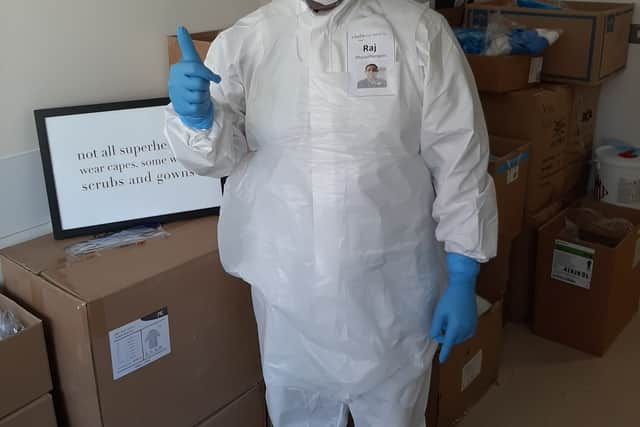
Going into ICU we need to put on our appropriate PPE: a full suit, special mask, goggles,
visor, gloves and shoe covers (Please see attached image). We have a picture of ourselves
on our PPE so other staff and patients can see the face behind the mask!!
Physiotherapy treatment of patients in ICU follows international best practise guidelines.
With COVID-19 ICU routines having changed considerably as patients are treated in prone
(lying on their tummy) as this is best for their lungs and oxygenation. I am part of this proning
team. It is very labour intensive and involves a lot of staff including anaesthetists, nurses,
physiotherapists, occupational therapists and other Allied Health Professionals.
I assess the patient’s ventilator and how they are responding to it. I assess their x-ray and
laboratory results to see if the lungs are improving and I use my physiotherapy techniques to
treat the lungs and suction (pass a catheter into the lungs) to remove excess sputum.
In addition to looking after the patient’s lungs and breathing, I also help patients move and
exercise in ICU. For some patients this means doing all their arm and leg movements for
them as they are unable to do so themselves. This prevents muscles and joints becoming
dec-onditioned and stiff. For other patients, the physiotherapist will get them out sitting (our
occupational therapy colleagues provide specialised seating) and standing by their bedside
and start an exercise programme. It’s heartening for the patient and the whole team when
they can stand by their bedside after being so sick!
10:30am Morning Break
It is very warm in the PPE and I often need to shower and change at break. I meet the
Physio team again to share information and discuss new patients. I then return to ICU.
Lunch: 13:00 -13:30pm
We usually have our lunch in the hospital canteen. However, at present to ensure social
distancing I have been having my lunch outside to get some fresh air.
I use this time to call my elderly mother back in India who is cocooning alone, also my sister.
13:30 - 16:30pm
I return to ICU or go to the COVID-19 ward with my colleagues and treat patients there.
In addition I may have a meeting to attend. I am a team member in the ICU COVID-19
subgroup and Naas Respiratory Team. These teams discuss the current COVID-19 status in
Naas General Hospital and all international guidelines and contingency plans for escalation.
COVID-19 has helped with a development of Telehealth within the hospital – using
technology for monitoring and assisting with treatments for our patients.
16:30pm
On a good day I get to go home. However of late I have been leaving later and later.
19:00pm
A number of nights each week I have had a video conference call with physiotherapists
working in ICUs across Ireland. We share information, experiences, guidelines and assist
with documentation for the Irish Society of Chartered Physiotherapists. Additionally I attend
webinars (these could be from the UK or Australia) and keep track of professional items on
Twitter!!!
Changes at home:
With three young kids all at national school and my wife who is a healthcare worker in a
nursing home we have had to adapt, like many other families.
o In the morning I set up home schooling so my wife can grab a few hours’ sleep after
coming off night duty.
o We take turns supervising home works - my wife contributes more ..! And dealing
with childcare is a struggle as we are both working.
o In the evening we take some time to exercise/play in the back garden – to keep us all
sane!
My personal reflections on the last 6 weeks:
From school closures to social distancing, from donning and doffing PPE, to rotas -
this pandemic brought many changes to our lives. This is similar for many healthcare
workers. It’s amazing how quickly and readily we all can adapt to new things for the safety
and health of our fellow human beings.
There is a fantastic ethos of team work in Naas General Hospital and COVID-19 has
strengthened that. I go home exhausted after long day’s work but delighted as a
physiotherapist to be able help patients and our nation at the time of this pandemic.