

BYD Seal 6 hybrid thinks it’s an EV

Road Test: Under the microscope this week is the latest from self-charging car from China
BYD have really established itself very quickly as one of the more premium Chinese brands.
They are, however, more known for their range of electric cars than anything with a petrol engine…that is, until recently.
You see, most manufacturers now realise that while EV uptake is certainly growing, it is not growing as quickly as had been initially anticipated. No surprise to many who predicted this situation, yet governments wanted to force motorists to adopt EVs almost blindly without considering the facts.
First of all, not everyone can afford an EV, and not everyone can charge at home. For example, in Ireland, it is estimated that some 40% of the motoring public live in housing where home charging is simply not possible.
As public charging is hugely expensive, that means for them an EV may not be practical. I am not even going to get into the ongoing discussion here as to how “green” or not they really are.
Now that European governments are realising their haste to push EVs on people was misguided, they have watered down their ban on petrol-engined cars by 2035. The EU has been moving towards revising this date to allow hybrids and low-emission combustion engine vehicles to continue after this date.
The net result is that many manufacturers are now focusing a huge amount of their investment on petrol hybrids, particularly self-charging hybrids.
That brings us nicely to BYD’s Seal 6 DMi. DMI stands for Dual Mode Intelligent, and this refers to the very clever self-charging system in this car.
First of all, it is a plug-in hybrid, but you could actually never plug it in (though this would be very inefficient) and still be able to drive on battery power. The reason for this is that the engine acts primarily as a generator to charge the battery. Therefore, always ensure some battery power is available for electric motoring. Of course, plugging in is the best and most efficient way to use this car, but its unique feature is that it always has battery power available whether you plug in or not.
In effect, a car that drives like an EV most of the time, but to give you range, the engine is charging the battery when necessary. In other words, the electric motor and battery are the primary power, while the petrol engine is secondary.
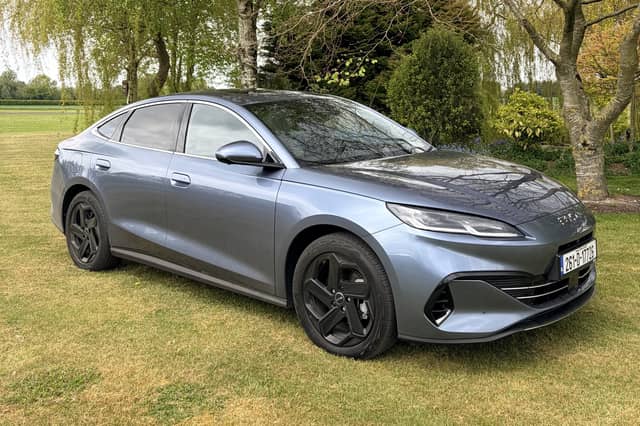
The new Seal 6 Dmi is available in two body styles, as a saloon and touring model (read estate) and with two trim levels namely Boost and, as tested here, the Comfort saloon version.
So how does it look?
I suppose it does not have standout styling that will turn heads, but I must say it is an appealing shape nonetheless. I quite like its looks as it's a refreshing break from an endless diet of SUVs.
What’s it like inside?
My first impressions are of a well-finished, well-designed, and indeed attractive interior. There is the now familiar BYD layout of a huge central touchscreen and a smaller digital driver display.
The main screen menus are reasonably good but not as intuitive as some European rivals, while the smaller driver's display can feel cluttered with rather small, hard-to-read digital data for some functions. MORE BELOW PHOTO.
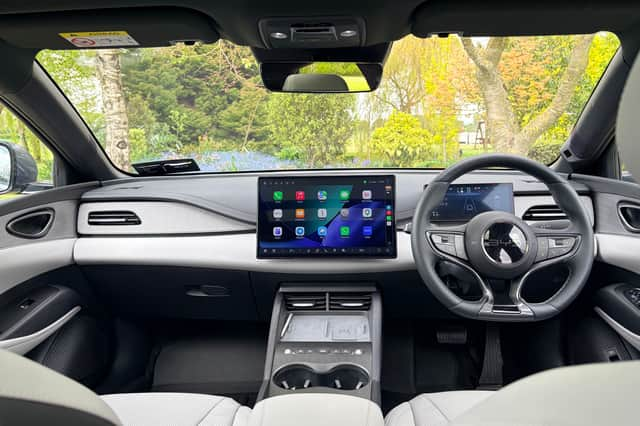
Pretty much all functionality is through the touchscreen; however, I will say with some relief that the voice activation is excellent, saving the driver from endless prods of the touchscreen while driving. Something I really consider dangerous and distracting!
The one-piece electrically adjustable heated front seats look and feel very comfortable, and there is lots of head and legroom both front and rear.
The fit and feel of everything is very good too. The upholstery (faux leather) looks luxurious. Overall, the interior is really roomy and is superbly equipped as standard. The boot in the Seal 6 is surprisingly big at 491 litres or up to 1,370 litres with the back seats folded down. That means it beats most rivals here on boot space, with only the Skoda Superb and Toyota Camry hybrid bettering it.
What’s under the bonnet?
BYD’s own in-house engineered highly efficient 1.5 litre petrol, and an electric motor powered by a 19 kWh battery. Drive is to the front wheels. From a full battery, up to 105 km range is claimed, I got 88km, which is excellent.
However, the really clever thing here is that the engine acts as a generator, constantly recharging the battery, thus you are really never at zero electric range. On some trips, up to 32 km of range was put back in the battery without plugging in. No wonder BYD call it a “Super Hybrid”.
On some trips, up to 32 km of range was put back in the battery without plugging in. No wonder BYD call it a “Super Hybrid”.
Without doubt, this is the most efficient PHEV I have ever tested. I returned a fuel consumption of just 5.2 litres per 100km. BYD claim a combined range ( that means starting with a fully charged battery) of some 1,455km. From my tests, it will achieve close to 1,300 km quite easily. That really is superb.
How does it drive?
The new Seal 6 is generally quiet and refined unless you prod that accelerator, for example, rapid overtaking, then that engine sounds rather coarse and harsh. It really runs on pure electric power for a vast percentage of driving time and slips seamlessly between both.
Basically, the engine really only becomes part of the propulsion when on motorways (even then, it's in combination with the electric motor, reducing fuel consumption) or if it kicks in to recharge the battery. The ride and handling are less impressive, with the car becoming unsettled on irregular road surfaces and feeling quite floaty over other surfaces.
The steering feel is quite numb too, low on feedback and not engaging. Premium German rivals win out here for sure.
Hugh’s Verdict
In short, the BYD Seal 6 scores hugely over a traditional plug-in hybrid as the battery never fully depletes, so you always have electric propulsion with the benefits of the fuel savings that brings.
Range is a non-issue as the engine keeps the battery charged no matter what. In my opinion, this is what gives this new BYD a huge advantage over other hybrid rivals.
Yes, it has its flaws. That engine is, of course, revved and the ride and handling is bettered by its rivals. However, as an overall package, I have to give the Seal 6 the thumbs up. Prices start at €37,490. The Boost version tested costs €40,990.
Pros: Incredible range; very well equipped; excellent warranty (battery 8 years or 200,000 kms car & engine 6 years 150,000 kms).
Cons: Harsh engine when revved; bettered by rivals for ride & handling; anonymous styling.
Checkout www.whichnewcar.ie for lots more road tests of the latest new cars.