

Mountmellick men's stint in English prison for Independence struggle
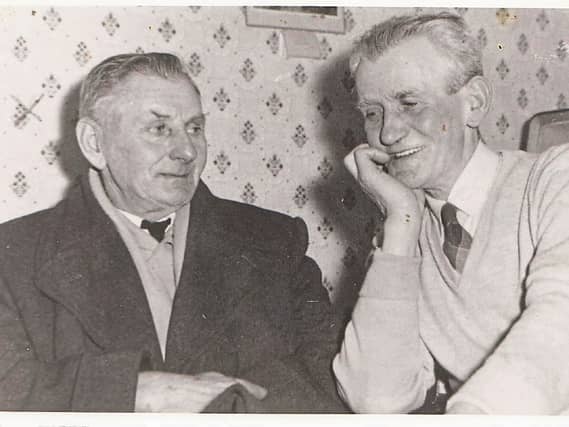

It was January 13th 1922 and despite the ominous ring of that dateline, a lucky day for the Irish in Pentonville prison.
“You're free Paddy,” said a warder unsmilingly to each one and all 43 of them trooped out of their separate cells buoyant and happy.
Among them were two Mountmellick men who need no local introduction - Dick McEvoy of Clonaheen and Willie Hibbitts who lived at St. Joseph's Tce, Mountmellick.
This pair were together through thick and thin and their friendship grew stronger with the years.
Like their comrades they were new men as they left the prison on January 13th 1922, delighted that all had persevered in their fight for recognition as political prisoners.
A String of Jails
A year earlier Willie Hibbitts was picked up in Mountmellick and the military nabbed Dick McEvoy in Ballyfin.
They were brought to Portlaoise Prison then to the Curragh and then from there to Mountjoy and Wormwood Scrubbs which was the receiving prison for Irishmen to be distributed throughout a string of jails in England.
Said Willie, “The Scrubbs was a tough place where they gave you a taste of discipline so that you would know where you stood wherever they sent you.”
Dick remembers it because of a peculiar depressing light which he described as a sort of foggy or grey light.
In the interior as they were conveyed to the boat chained in sevens, a black and tan officer looked in to give a cheerful comment.
“If anyone tries to take any of you chaps from us, I'll put three shots into each prisoner.”
In Pentonville, which had accommodation for a thousand prisoners in an enormous range of cells 75 to a row in four blocks, the 43 Irishmen were scattered at various points to keep them from mixing.
In Pentonville, Willie Hibbits and Dick McEvoy were employed in the kitchen and despite the vigilance of warders (some were brutal in their treatment of the Irish prisoners) they availed of very opportunity to get news out and in, disseminating it among their comrades.
Casement's Grave
Part of their duties included the emptying of swill buckets.
On their way across the exercise yard they passed the grave of Sir Roger Casement beside that of the notorious Dr. Crippen with its simple tablet inscribed R.D.C 3-8-16.
On each occasion they downed buckets and saluted the grave.
Said Dick, “The warders didn't like it, some of them pushed us on and said forward traitors, in spite of all that we kept it up.”
Comd. Tom Hales (Bandon) who suffered considerably at the hands of the British Forces was in charge of the Pentonville prisoners.
He bore the marks of severe beatings but defied his captors.
Among the prisoners were the late Sean O'Gorman of Clonaheen, 'Flash' Foley and Larry Shaw (Carlow), Bill Doyle (Wexford), Gus Delaney, Harry Bateman, John Joe Flynn Bedmont (Navan), Lukeman (Kilkenny) and Ward of Roscommon as well as Paddy Byrne of Mullingar who wore his first long pants in prison.
During their imprisonment the Irish (acting on instructions) refused to wear the prison clothes and maintained their demands for treatment as political prisoners acting on warder to make a present of the clothing to Lloyd George.
When Hales was transferred from Pentonville in an effort to leave the Irish prisoners leaderless all hell broke loose as his comrades wrecked cells as a reprisal.
Their jailers responded by putting them in irons and restricting their diets to bread and water.
The governor of the prison was Irish born, Major Wallace Blake.
The prisoners were not allowed to talk and made and amended mail bags.
Willie Hibbitts said he thought he had seen all the mail bags in the world at Wormwood Scrubbs until he went to Pentonville.
Dick found a solution to the boredom of repairing mail bags - he used one as a prop for his book pretending to be industrial with needle in hand.
Michael Collins
Willie told me that meetings of the visiting committee were held on every third Tuesday the same day as the fair in Mountmellick and these visits were the butts of many jokes.
When Michael Collins visited the jail Willie was called in to see him in the Governor's office.
He thought he was chosen as his cell was near the office.
Collins asked him his name and brigade and when the governor interjected to complain of the trouble he had with the prisoners, Collins commented that in any prison in which he (Collins) was interned he was classed as one of the worst so he had nothing to say.
In that case Michael Collins also visited Dick McEvoy in his cell saying, “I am Michael Collins” with Dick saying as he did not know Collins he told the visitor their conversation would be very short and he (Collins) replied, “I don't blame you for that, I admire you. You are going to get good news before long.”
Collins sympathised with the plight of the prisoners and said he had promised his old comrade Hales before that they would be treated as political prisoners.
Willie said that after the visit by Collins the prisoners knew something was in the wind, they immediately demanded that they should all be put together in cells on the same landing. This was agreed.
Christmas dinner
Christmas dinner 1921 consisted of bull beef and potatoes.
Willie Hibbitts said, “The meat normally served was reputed to be horse flesh” but they did get real pork and beans once a week.
A ditty composed by one of the prisoners about the poor meat ration read,
“Around and around and around and around till I thought I was mistaken when in between two beans at last I spied my piece of bacon.”
Soldiers song
Willie told an amusing story of a Jew among the prisoners who showed a particular fondness for the Irish and was sympathetic towards the cause.
The Jew insisted that Willie write out in full the words of the Soldiers Song and a number of the other patriotic songs.
This he did and the Jew learned these off by heart with amazing rapidity.
As the prisoners filed across the exercise yard the Jew prodded Willie urging him to hum the air so that he could sing the words.
His new found friend was a reliable source of information which was passed on to all the prisoners.
When about to leave the prisoners asked the governor for permission to visit Casement's grave together.
They marched to the plot and kneeling recited a decade of the rosary in Irish.
The oration was delivered by the Major Paddy Byrne.
Before marching out, each of the men took a stone from the grave as a souvenir and saluted smartly.
Willie also brought home his prison cap and hymn book.
Both Dick and Willie served with the 2nd Battalion, Old IRA. Dick was a farmer while Willie was a foreman with Irish Grain Ltd, Mountmellick.
He was previously a foreman maltster with Codd and Co in the same premises where he had had over 40 years of service.
This article was originally published some years ago.