

PHOTOS: Exciting finds at archeological dig at Rock of Dunamase

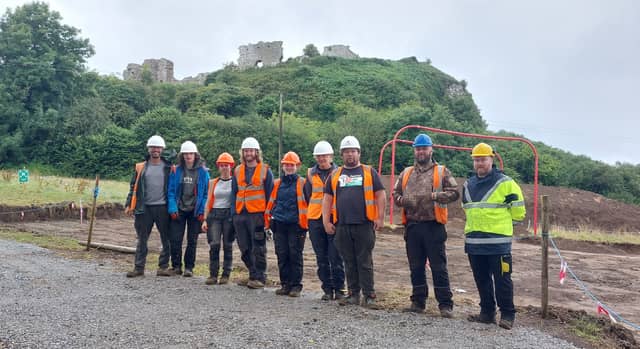

Laois historic artifacts 800 years old uncovered daily ahead of new carpark
An exciting archeological dig at the Rock of Dunamase has already unearthed multiple 800 year old artifacts, with a possibility of real treasure to be discovered in the coming weeks.
Laois County Council has commissioned the dig on the site of a new visitor carpark enhancing tourism facilities at the iconic Laois visitor attraction.
The carpark is due to be opened in Spring 2026, at the base of the historic ruined fortress, which lies off the main N80 road between Portlaoise and Stradbally.
The dig began on June 30, and it may last up to three months, because the entire site must be examined before it is overlaid with the carpark.
The excavation is led by Laois based archeologist Colm Flynn, of Horizon Archeology.
“This project is a career highlight for me, particularly as Laois is my adopted home,” he said.
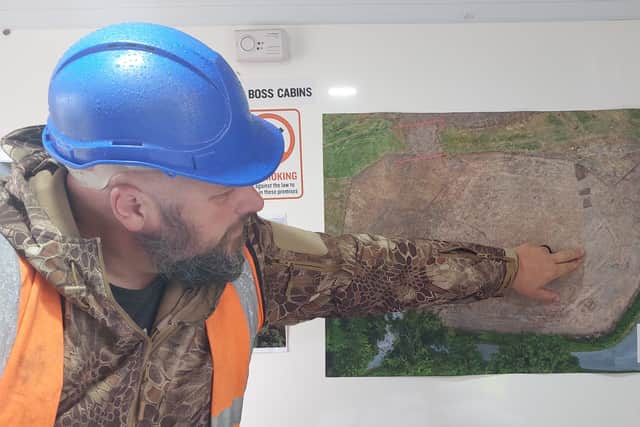
Archeologist Colm Flynn showing dark areas where a high defensive wall would have stood 800 years ago.
The dig team includes experts from Italy, Spain and Poland, Kildare, Meath, Carlow and Offaly. The field was first scraped clear of topsoil, so that the older subsoil, can be carefully dug with small hand tools, section by section.
Colm first explains a piece of green glazed ceramic pottery.
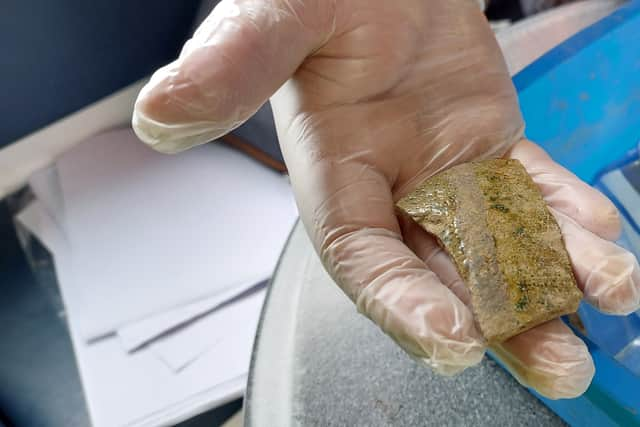
The Kilkenny ware pottery fragment.
They have found many fragments of Leinster cooking ware, which was made and used across the provence.
“It went on top of an open fire so its often blackened. You can run your finger over it and feel the thumb impression that the maker made before it was fired. That’s 800 years of history in your hand,” he said.
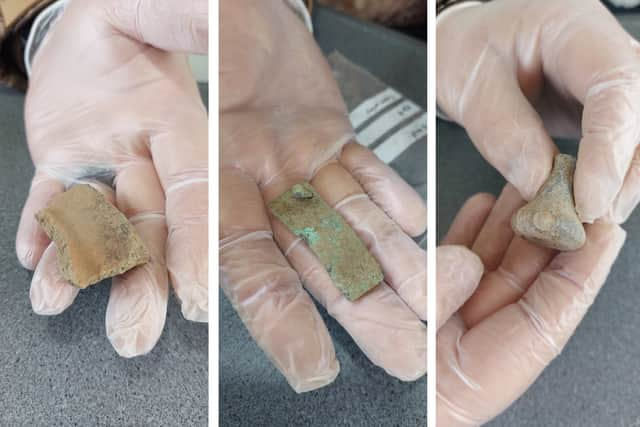
Leinster ware, the metal riveted artifact, and the 'doorknob' a carved bone gaming piece, all found at the Rock of Dunamase dig.
“It is illegal to use metal detectors in Ireland without a licence. Anyone trespassing here will be prosecuted,” Colm said.
The piece he found is made of a copper alloy metal, with a tiny nail rivet still piercing it.
“It might have been a strap handle, probably from a belt or a bible clasp. It’s the high medieval period, there’s a fair bit of workmanship in this,” he said.
He describes the next find as very rare, “we are delighted”. Nicknamed a doorknob, it is a delicately whittled piece of animal bone to make what looks like a chess piece.
“It’s a gaming piece, they often had drinking games. We weren’t sure what it was at first but there is a similar piece found in Cork with the same stamp,” the archeologist said.
The crew have also found a handful of copper coins so far.
“None are as old as the castle, we will have to clean them in correct conditions in the lab as the clay may have bonded to the metal. They are 18th and 19th century coins,” he said.
There is every chance that they could yet find a Laois version of the Tara Brooch.
“The Anglo Normans have more dress items than the Gaelic Irish so yes there is potential to find such jewellery,” Colm Flynn said.
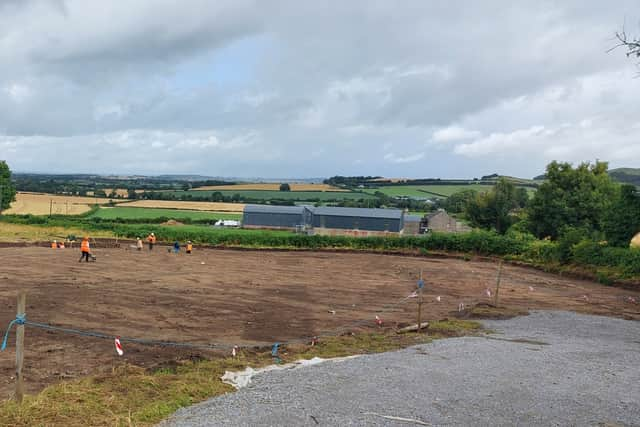
There is evidence of building structures, and still the black ashes and red earth where food was cooked on fires, and where grain was dried to preserve it for the winter.
The recent rain is washing away the subsoil revealing new fragments of pottery and animal bones in multiple places.
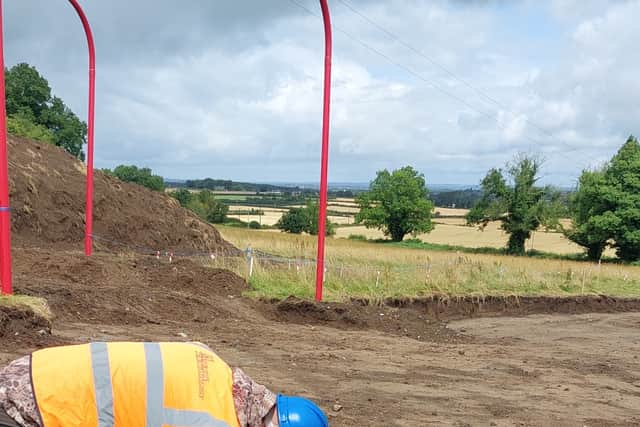
A red and black patch showing the presence of a fire area from 800 years ago.
The Laois based archeologist explained the history of the Rock of Dunamase.
“Marshalls built the castle on top of an older defensive dún. Marshall had married Strongbow and Aoife’s daughter and inherited it. It passed through two or three more Anglo Norman families then in the 14th century their power was hemmed back with the Black Death and the Bruce Invasion, what follows we call the Gaelic Resurgence.
"The O’Moores came into their own and had it probably from the late 14th century until the English plantation in the 16th century.
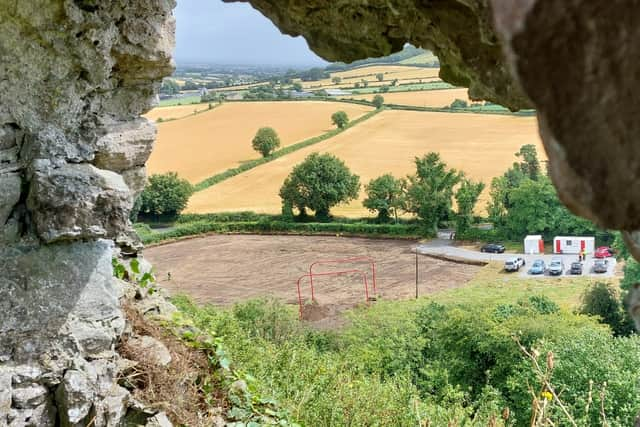
View of the dig site and new carpark, from the top of the Rock of Dunamase. Photo: Leinster Express
Gavin Cobbe from Killenard is an acting Senior Executive Engineer with Laois County Council, in their capital projects office. He will be onsite for much of the build.
“It is exciting to be a part of. It’s such an iconic monument. I bring the kids here regularly. This is probably a once in a lifetime opportunity to see items that haven’t seen the light of day in 800 years, I don’t think I’ll ever be on a site like this again,” he said.
The new carpark will also have toilet facilities, thanks to the cooperation of the Church of Ireland community. Their 19th century chapel will be opened during daylight hours for visitors to use their upgraded toilets, and also to visit its pretty interior.
There will also be two power points providing foodtrucks with the potential to park onsite. For safety, the carpark will be closed outside of daylight hours, as the Rock is a dangerous to visit, even in daylight hours. It has unprotected steep rocky drops, as well as a deep hole likely made when quarrying stone to build the castle, later used as a dungeon or 'oubliette' for unlucky prisoners.
“People need to be responsible and supervise their kids. We will be opening a new pedestrian laneway up to it so there is a safe way up. There won’t be any lights as they are a distraction to nature. The castle is the responsibility of the OPW, we are responsible for the safety of visitors to the carpark,” Mr Cobbe explained.
The new carpark is due to be completed by mid 2026.