Search


26 Mar 2026
Search
26 Mar 2026

Please allow ads as they help fund our trusted local news content.
Kindly add us to your ad blocker whitelist.
If you want further access to Ireland's best local journalism, consider contributing and/or subscribing to our free daily Newsletter .
Support our mission and join our community now.
To continue reading this article, you can subscribe for as little as €0.50 per week which will also give you access to all of our premium content and archived articles!
Alternatively, you can pay €0.50 per article, capped at €1 per day.
Thank you for supporting Ireland's best local journalism!

Pat Fahey and his dog Mitzi at home in Portlaoise.

A Laois man whose long lost sister helped to save his life through cancer screening, is urging others to get tested.
Retired Bank of Ireland official Pat Fahey who lives in Portlaoise has made it his mission to tell people how to find out if they are more susceptable to cancer, and possibly save their lives.
He first told the Leinster Express / Laois Live the dramatic tale of how he found out he had a sister, aged in his 40s.
“My mother never mentioned the fact that we had a sister.”
His mother became pregnant outside of marriage in the late 1940s and was forced into the Sean Ross Abbey mother and baby home in Tipperary, the same institution featured in the Irish film Philomena.
Her father died aged 50 with colon cancer, during her stay at the home. She was not allowed to attend his funeral.
Her baby girl was adopted aged 3, possibly against her will, to a childless Irish couple living in New York.
Pat's mother then moved to Birr, met his father who was a widow 33 years her senior, married him and had her two sons.
She died in 1988 also from colon cancer aged just 63.
Out of the blue, in 1993, Pat's brother was contacted by Ann, who had tracked him down with the help of a friend in the FBI and the Gardaí.
“She had her passport with my mother's maiden name, Griffin and knew she was from Tipperary.
“When my brother told me there was a lady saying she was our sister, it took me only 30 seconds, thinking about how my mother always seemed somewhat sad, and I believed it,” Pat said.
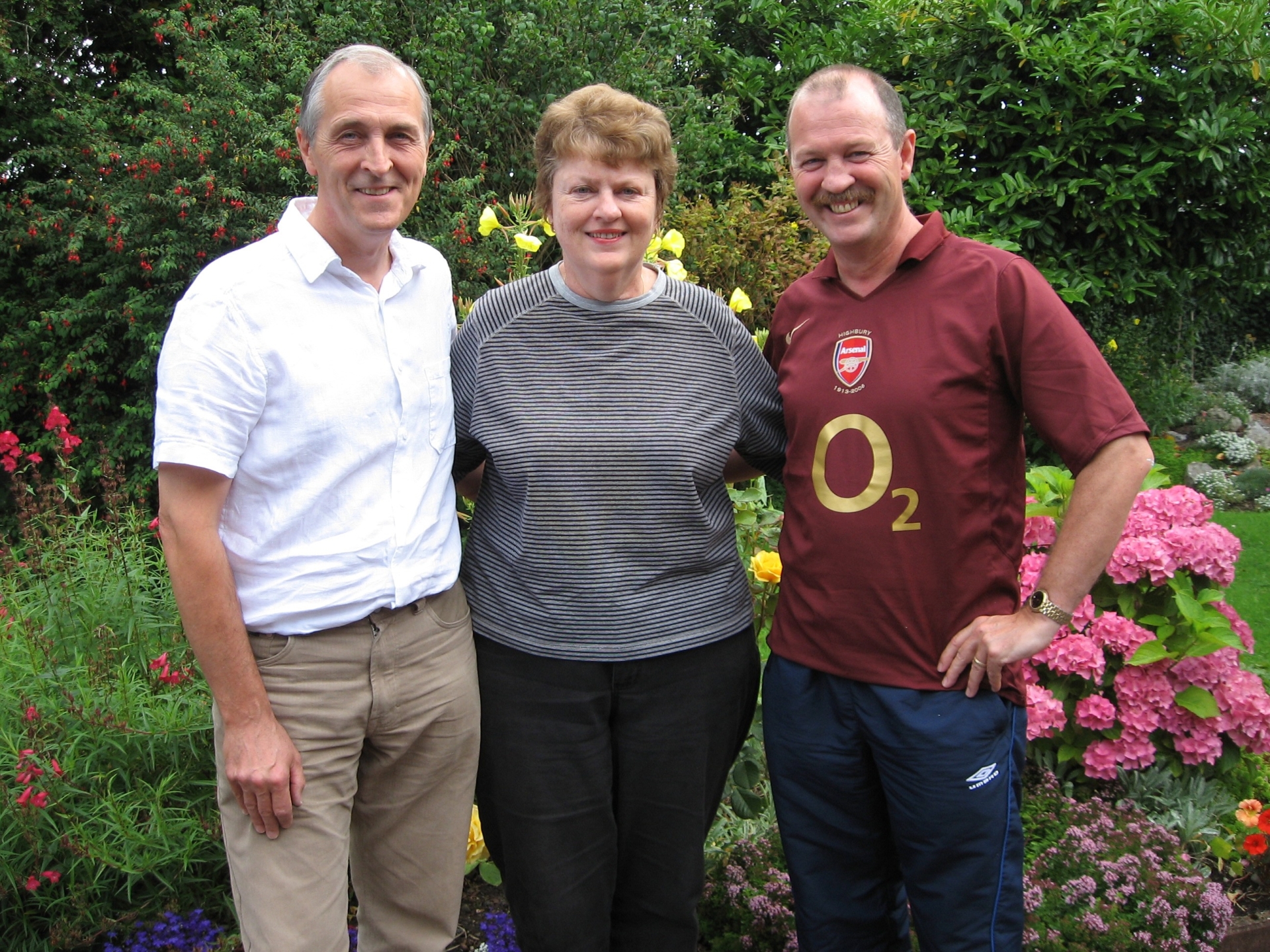
Pat Fahey with his sister Ann and brother Tom.
Pat now keeps in regular contact with his sister. He bears no ill will to the religious order.
“People blame nuns, but it was the whole of society. Her father disowned her. The church played a role, but I believe the nuns started out thinking they were doing their best,” he said.
His sister Ann is a nurse, and was diagnosed with colon cancer too, aged 35.
“In 2002 she developed about five more primary cancers, and she reckoned something was going on.
“She took a genetic test and it showed this Lynch Syndrome. It's a faulty gene that increases your chance of certain types of cancer and it makes it grow faster. It affects one in 300 people.
“People associate it with colon cancer, but it's also endometrial, ovarian, kidney and urethrar. Children of a parent with Lynch Syndrome have a 50% chance of having it too. If both parents have it, generally their children will develop cancer early.
“Myself, my brother and my sister have all now had colon cancer.
“My sister had no medical history because she was adopted so she really wanted to find out. She is a tenacious lady who was on for us to all get tested. So between herself and my wife, it sunk in, and I started getting annual colonoscopies.
“On my third one, at Tullamore hospital, cancer was discovered. It had gone to my lymph nodes so I had to get chemotherapy.
“I had no symptoms. If I had not known, cancer would have spread through me.
“My brother got cancer a year later. We both weren't tested for the gene until afterwards,” Pat said.
“It is a simple blood or saliva test. Your doctor refers you. Cells constantly divide, and they can have mistakes. In general bodies can handle those mistakes but with Lynch Syndrome, there are more mistakes and they keep multiplying.
“It is similar to the BRCA gene, for breast and ovarian cancer, where people including Angelina Jolie have had mastectomies to prevent future cancers.
“They say that 90% of people are unaware of these syndromes. Once you are aware, you can go and get yearly colonoscopies. They remove any polyps or lesions, invariably before they are cancerous,” Pat explains.
He was so concerned at the lack of knowledge of Lynch Syndrome, both in the public and the medical world, that he set up a website, a blog and a Facebook support page.
“I felt there was little or no information. I'm no medic but in the past, doctors sort of waited for cancer to develop to fix it, as opposed to being proactive.
“If you have a family history of cancer, ask your doctor about a test.
“It's on the HSE's National Cancer Control Programme as an aim, and on their ten year cancer strategy to have it implemented. However it is not properly funded. They have only maybe a quarter of the staff they should have.
“If you are referred for the test on the public health system, you could be waiting for two years. If you go private it might only be two months.
“If you don't know what mutation to look for, they could have to check for 70 or 80 of them, and it can cost €1,600. If it is one mutation its about €800,” he said.
He says that genetic counselling is important.
“You have to consider how you live with knowing, how your kids and parents will feel. You can ask your doctor to refer you to a genetic counsellor,” Pat said.
He says men are less inclined to get checked out.
“In my Facebook group, 90% of members are female, women are generally more proactive, I think men feel they should be strong or probably it's fear of baring all at the doctors,” he said.
He wants to spread awareness about the tests.
“If you have a possibility of a genetic disorder, I feel you have a responsibility to your children to get tested.
“Cancer is no longer taboo, people have gone through it and thousands live with it. There is hope out there, it's not all doom and gloom. There is even advanced research on a vaccine, speeded up by covid vaccine research. I've grandchildren, I hope by the time they are old enough to start tests in their mid 20s, there might be a vaccine. The bottom line is, if this is in your family, you need to know.
“There needs to be more funding put into prevention rather than waiting for cancer and spending months in treatment, out of work. I'm not an accountant but it's a no brainer,” Pat Fahey said.
For more information, see www.lynchsyndrome ireland.com , see the Facebook page or or email lynchsyndromeirl@gmail.com

Subscribe or register today to discover more from DonegalLive.ie
Buy the e-paper of the Donegal Democrat, Donegal People's Press, Donegal Post and Inish Times here for instant access to Donegal's premier news titles.
Keep up with the latest news from Donegal with our daily newsletter featuring the most important stories of the day delivered to your inbox every evening at 5pm.

This publication supports the work of the Press Council of Ireland and Office of the Press Ombudsman, and our staff operate within the Code of Practice of the Press Council. You can obtain a copy of the Code, or contact the Council, at www.presscouncil.ie, Lo-call 1800 208 080 or email: info@presscouncil.ie.