

Royal Irish Constabulary commemoration not a 'celebration' of the Black & Tans insists Minister Flanagan

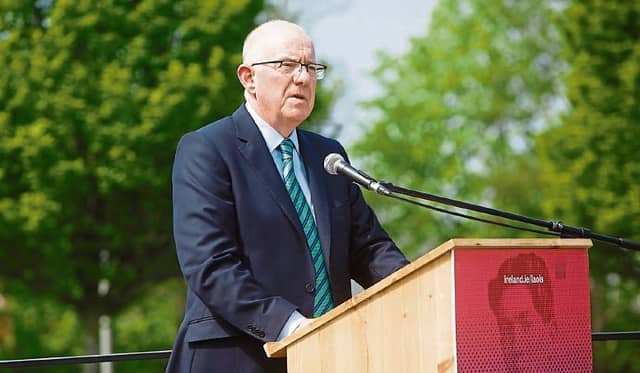

Laois TD brings Hollywood star into the debate
The event to remember the Royal Irish Constabulary (RIC) will be 'modest and solemn' and is not a 'celebration' of the Black & Tans, according to Laois TD and Minister for Justice Charlie Flanagan.
Minister Flanagan issued a statement in the wake of the controversy sparked by the decision of the Mayor of Clare not to attend. Defending the event has also brought Hollywood star and Irish actor Michael Fassbender into the row.
The Laois TD also hit out at critics of the event labelling their views as headline-grabbing and a "step backwards to a more narrow-minded past".
“The approach to the Decade of Centenaries has made clear that there is no hierarchy of Irishness and that our goal of reconciliation on the island of Ireland can only be achieved through mutual understanding and mutual respect of the different traditions on the island,” he said.
He says that under the guidance of the Expert Advisory Group on Centenary Commemoration, he, on behalf of the Government, will host an event to commemorate the place of the Royal Irish Constabulary and Dublin Metropolitan Police (DMP) in Irish history on January 17.
“It is not a celebration. It is an acknowledgement of the historical importance of both the DMP and the RIC, and is in no sense a commemoration of the “Black & Tans” or the “Auxiliaries”, he said.
Minister Flanagan responded to opposition to the event which has included some from Sinn Féin representatives in his own constituency. The Fianna Fáil Mayor of Clare Cathal Ruane said it is "wrong to celebrate and eulogise" the RIC, "an organisation that was the strong-arm of the British state in Ireland".
“It is disappointing to see some public representatives abandon the principles of mutual understanding and reconciliation in an effort to gain headlines. This attitude, combined with a distortion of the nature of the commemoration, is ill becoming of any public representative and represents a step backwards to a more narrow-minded past characterised by a hierarchy of Irishness,” he said.
He said the event is one of a large number of events taking place during this decade to "acknowledge and commemorate significant" events or developments in the history of our island one hundred years ago.
"The Decade of Centenaries has, to date, been characterised by an open-minded non-partisan factual approach to our history. It has provided us with the opportunity to remember all of those who died over the period.
"The office-holders invited to the modest and solemn commemoration on 17 January are invited in their capacity as representatives of their county, city or party as the case may be. They have not been invited in a personal capacity," he said.
The Laois TD said sensitivities are not the preserve of one side.
"There is no question but that there are very real sensitivities involved here. I acknowledge that. But there are sensitivities on both sides. The RIC has found itself on the wrong side of history.
"The intolerance that was often characteristic of Ireland in the past sometimes forced people to deny their own family histories and airbrush parents, grandparents and siblings out of the picture for doing no more than serving as an army officer or police officer to support their families. It should be noted that the vast majority of Irish people who served as army and police officers did so with honour and integrity," he said.
Minister Flanagan said the complexities of Irish history has been highlighted and many people have explored their family history, often discovering ancestors who served in the army and/or police as well as playing a role in the fight for an Irish Republic and/or Home Rule.
He said the historian, Diarmuid Ferriter, among others, has highlighted this in his writing noting that Michael Collins’ uncle served in the RIC while the author Sebastian Barry had one grandfather in the British Army and another who was an Irish Republican.
He also referenced a Hollywood star in his statement.
"The actor Michael Fassbender’s great grandfather was in the RIC while Fassbender is also related to Republican leader Michael Collins. So many other Irish families share this complex history and these facts should be explored and acknowledged as all the threads of our history, within families and as a nation, make us who we are today as a people," he said.
Minister Flanagan said the centrepiece of the Decade of Centenaries was 1916 Rising but there have also been commemorations of the First World War, the Labour movement, female suffrage and the struggle for Home Rule. He said the Government commemoration in 1916 acknowledging the 125 British Army officers who lost their lives in the Rising while a Necrology Wall of Remembrance in Glasnevin Cemetery lists all those who died in the Rising, including rebel combatants, civilians, police officers and members of the Army.
"These commemorations are about our history, not our mythologies, and as Minister for Justice and Equality, I am happy to endorse the recommendation of the Expert Advisory Group that we commemorate the place of the Royal Irish Constabulary and Dublin Metropolitan Police in Irish History," said the Minister.
The Department of Justice said the roots of the Dublin Metropolitan Police stretch back into the eighteenth century and it was merged with An Garda Síochána in 1925. The Royal Irish Constabulary (RIC) was founded in 1836. By 1870 it has 12,000 members, most of them Catholic. It operated all over Ireland but not Dublin and was disbanded in 1922.
The event, which will be held at Dublin Castle, will be attended by Garda Commissioner Drew Harris.