

'Unauthorised and unacceptable' covert surveillance carried out at the Midlands Prison in Laois, report finds
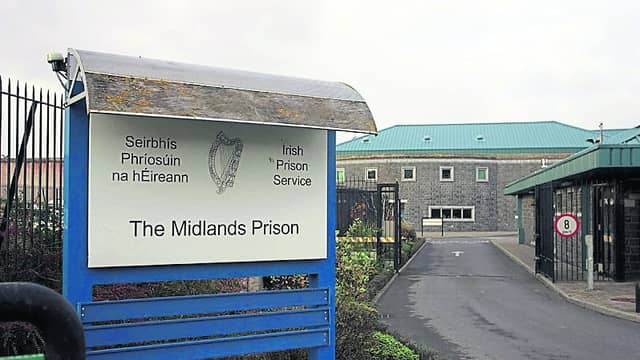

Members of a prison security group carried out unauthorised surveillance on staff and visitors at the Midlands Prison over a two-year period, according to the Inspector of Prisons report which has been published today (Thursday).
The reported was ordered by the Minister for Justice, Charlie Flanagan in the wake of a High Court affidavit by an employee of the Irish Prison Service (IPS) alleging several instances of wrongful surveillance by the group.
The Inspector's report says it found evidence that a tracker device was placed on a prison officer's car and on prison service vehicles, and a covert camera was installed in the prison. Conversations between inmates and visitors were recorded in 2012 and 2013.
However, it found no evidence that solicitor client conversations were monitored.
The Inspector, Patricia Gilheaney concluded the activities were carried out without the knowledge or authorisation of senior management within the prison service.
The Prison Service has handed evidence that may have been unlawfully obtained to the gardaí and notified the Data Protection Commissioner.
The report states that a small number of personnel in the Prison Service's Operational Support Group (OSG) became so concerned about drugs and other contraband being smuggled into the Midlands Prison that the services of two private companies were engaged to carry out surveillance. The report says that these services were "procured outside normal rules."
These companies were paid over €29,000 for services including covert surveillance, tracking and CCTV.
It found evidence that a tracking device was fitted to the private car of a prison officer suspected of smuggling drugs into the prisons, but no drugs were ever found and the Inspector could not make a finding that the allegation was true.
A device was also fitted to prison service vehicles. A private company showed an officer how to attach and monitor the tracker.
The "unauthorised and unilateral" surveillance was carried out over a two year period in 2012 and 2013 without the knowledge of senior management at the Prison Service.
The report also found evidence that in an OSG operation in January 2012, a van containing drugs and telephones entered the Midlands Prison and was seized by the OSG.
Justice Minister Charlie Flanagan said he is concerned at the findings that a small number of personnel may have acted wrongfully, going far beyond their remit and engaging in unacceptable practices.
Main findings
The Inspector’s report found that:
· €29,000 was paid by the IPS to two private security firms in 2011 and 2012 for services including covert surveillance, tracking and CCTV, and that these services were procured outside normal rules;
· there is some evidence to corroborate the allegation that covert surveillance was carried out in a unit in the Midlands prison in 2011;
· there is some evidence to support the allegation that covert surveillance was carried out in an office in the Midlands prison between October 2011 and December 2012;
· there is no evidence to corroborate the allegation that solicitor/client consultations were deliberately monitored;
· there is some evidence to support the allegation that, in an OSG operation (in January 2012 rather than 2013 as alleged) a van containing drugs and telephones entered the Midlands Prisons and was seized by the OSG.
· the only evidence to corroborate the allegation that a prisoner was recruited as an informant and supplied with a telephone is that there was such a prisoner in custody at that time;
· the allegations concerning deaths in custody (about there having been no protocols or procedures in place for the preservation of a scene following a death in custody) have been corroborated (although the report also found that IPS management had engaged with the previous Inspector of Prisons on this issue and that progress had been made to address it); and
· there is some evidence to corroborate the allegation that a tracking device was placed on the private car of a prison officer, but that the Inspector cannot make a finding that this allegation is true.
The report (at paragraph 11.5) states that:
"The evidence does suggest that in an effort to curtail the flow of contraband into IPS facilities, a small number of personnel within the OSG acted in a unilateral manner which was beyond the original remit of the OSG, that does not appear to have followed any standard procedural or operational guidelines and which fell outside of acceptable practice. There is a conflict of evidence as to whether these activities were authorised by the then OSG governor. There is no substantive evidence to corroborate the allegation in the affidavit that these activities were carried out with the knowledge or authorisation of senior management within the IPS.”
During the course of the investigation, the IPS brought to the attention of the Inspector evidence that may have been unlawfully obtained or have involved the unauthorised collection of personal data. The Inspector asked the IPS to provide this evidence to An Garda Síochána and the Data Protection Commission. The IPS handed this evidence to the Garda Síochána and notified the Data Protection Commissioner. The Inspector considers that An Garda Síochána and the Office of the Data Protection Commissioner are the appropriate bodies to carry out any further investigations into this material.
Recommendations
The report makes a number of recommendations, principally calling for:
· a review of the OSG;
· a revision of procedures for the approval of invoices;
· staff in prisons to be accountable to the most senior governor in the prison to which they are assigned;
· the introduction of a code of ethical behaviour;
· a review of policies and procedures in relation to information-gathering, surveillance and CCTV;
· more stringent screening of persons, including staff, entering prisons;
· adherence to public sector procurement procedures.
Commenting on the report, Minister Flanagan said, "I am grateful to the Inspector of Prisons, Patricia Gilheaney, for her report into allegations of surveillance or other wrongdoing in the Prison Service.
"It is essential that the IPS makes every effort to prevent drugs, weapons and other contraband from entering our prisons. However, all actions taken must be absolutely lawful and based on clear, authorised and accountable procedures. Prison officers have a very difficult job to do but they also have an important job to do and it is vital that the highest ethical and professional standards are maintained.
"I am concerned at the findings in the report that a small number of personnel in the OSG may have acted wrongfully in the past – going far beyond their remit and engaging in unacceptable practices.
"In the course of her investigation, the Inspector asked the IPS to provide certain material obtained during the course of her investigation to both An Garda Síochána and the Data Protection Commission, each of which has an important and independent role in this case. The Inspector notes that these are the appropriate bodies to carry out any further investigations relevant to that material.
"The Inspector has made a number of recommendations and these will all be fully addressed. As the allegations investigated relate to the period 2010 – 2013, a number of the issues arising have already been addressed; for example, the need for clear and robust policies and procedures in relation to the investigation of deaths in custody.
"I have engaged extensively with the Director General of the Irish Prison Service, Caron McCaffrey, and I have every confidence in her leadership and capacities and her absolute commitment to ensuring our prisons operate to the highest standards."
Specific steps
In the light of the findings and recommendations of the report, the Director General of the Irish Prison Service, Caron McCaffrey, has decided upon the following steps:
a) OSG to be reviewed: In her report, the Inspector recommended that the IPS carry out a review of the functions of the Operational Support Group (OSG). The Director General has commenced such a review and will submit a report to the Minister with her conclusions and recommendations within 8 weeks. This review will also cover the recommendations made by the Inspector in relation to CCTV, information gathering, surveillance and screening.
b) Ethics. The Director General will introduce into the IPS a new Code of Ethics later this year. This new Code will emphasise the importance of transparency and openness in the prison system.
c) Clear guidelines on invoice approval. Since the period covered by the Inspectors report (2010-2013), the Irish Prison Service has updated procedures that set out a number of responsibilities when approving a purchase order or an invoice. These include compliance with Procurement Policy and checking that all supporting documentation is in order. A check on the procurement status of suppliers is also undertaken prior to them being set up in the payment system. In the context of the transition to the National Shared Services Office, Financial Management Shared Services Project, various procedural changes are pending that will further improve payment processing in the Irish Prison Service. These include centralising requisitioning and invoice processing. The Prison Service's procedures will be amended to reflect these changes as they occur.
d) Accountability of staff. Allegations of wrongdoing will, subject to any investigation by An Garda Síochána, be addressed by the Director General in accordance with disciplinary procedures.
Revised governance and oversight
The Minister welcomes these specific and necessary steps being taken by the Director General, and believes that this report also affords an opportunity to address related governance issues that arise on a broader strategic level. To that end, the Minister will shortly put in place a process to appoint a new Prisons Board under an independent chair.
The Board will, directly or through its committees, uphold professional standards of performance across all prison service activities, as well as develop and monitor more clearly defined ethical standards and organisational values.
In particular, a new audit committee will report directly to the Board. Two other committees, dealing with risk and culture, will also report to the Board. An internal audit function will also be established which will review and help improve key internal controls and control systems on a continual basis. The audit committee will advise the Board on the strategic processes for internal control and governance.
Announcing these developments, Minister Flanagan commented: "The establishment of a new Prison Service Board, with an independent chair, along with new audit, risk and culture committees, will significantly strengthen governance of the Irish Prison Service, and enhance accountability, efficiency and effectiveness.
"This approach is consistent with the review of the governance relationship with Justice Agencies that is taking place alongside the very significant Transformation Programme in my Department – it is a further important step in the development and modernisation of the Prison Service. I am taking steps to put a Board in place as soon as possible."