Rest in Peace James McEvoy
Search


30 Mar 2026

Please allow ads as they help fund our trusted local news content.
Kindly add us to your ad blocker whitelist.
If you want further access to Ireland's best local journalism, consider contributing and/or subscribing to our free daily Newsletter .
Support our mission and join our community now.
To continue reading this article, you can subscribe for as little as €0.50 per week which will also give you access to all of our premium content and archived articles!
Alternatively, you can pay €0.50 per article, capped at €1 per day.
Thank you for supporting Ireland's best local journalism!

Avril with her Parents Dan and Ann Marie. Photo: Kyran O'Brien/DCU Communications

A Laois cancer survivor drew on her personal experience to explore the after-care ‘support cliff’ faced by childhood leukaemia patients and their families for her PhD project.
Avril Deegan from Cullohill graduated with a PhD in Psychology from Dublin City University (DCU) this Spring.
“I had cancer myself when I was a child, so it was always something I was interested in,” Avril explained.
What she discovered was a ‘support cliff’ where parents and children are left on their own to deal with any of the longer-term impacts, once they exit the treatment programme.
“A lot of parents that I spoke to were breaking down during the interviews because it was the first time anyone had asked them how they're doing afterwards,” she said.
Avril was just five when diagnosed with leukaemia and admits she remembers very little of the treatment. It wasn’t until much later that she began to reflect on having been through such a life-threatening experience at such a young age.
“I didn't question it initially, but when I was in my 20s, I started looking back at pictures and things, and I was wondering what the hell was that all about?”.
READ NEXT: Laois musician 'blown away' following RTÉ appearance
As an adult, she now appreciated how traumatic the experience must have been for her parents. But in conversations with them, she was surprised to learn that the hardest part for them was returning to ‘normal life’. They described how there was a lack of support, and they didn’t know where to turn for help, once Avril’s years of intensive hospital treatment had ended.
With this in mind, Avril wanted to explore whether anything had changed in the intervening years for childhood leukaemia survivors and their families.
One of her first steps was to reach out to Paediatric Haematologist Prof Owen Smith, one of the consultants who had treated her in Crumlin Children’s Hospital all those years ago. She was delighted when he agreed to be involved in the project as one of Avril’s supervisors, alongside Clinical Psychologist Dr Chiara Besani, and her lead supervisor, Dr Simon Dunne from DCU School of Psychology.
The research was conducted through surveys and interviews with parents and children, capturing their post-treatment experiences. In particular, she wanted to talk to children individually, to get their unfiltered views.
READ NEXT: PICTURES: Special guest joins Laois parishioners on Palm Sunday
She was surprised to see just how resilient the younger children were. They tended to accept treatment as normal and “presumed every child went to hospital, got their appointments, went home.”
In fact, the first child she interviewed seemed unaware of how sick they had been. “I asked them what it felt like to have had cancer and they didn't know what I was talking about.”
Meanwhile, rather than displaying signs of trauma, most younger childhood cancer survivors had good memories of their time in treatment because it meant days off school, and a treat meal afterwards. This chimed with Avril, whose clearest memories of her time in treatment were the happier moments, like weekend trips with the family to Barretstown. CONTINUE READING BELOW PHOTO
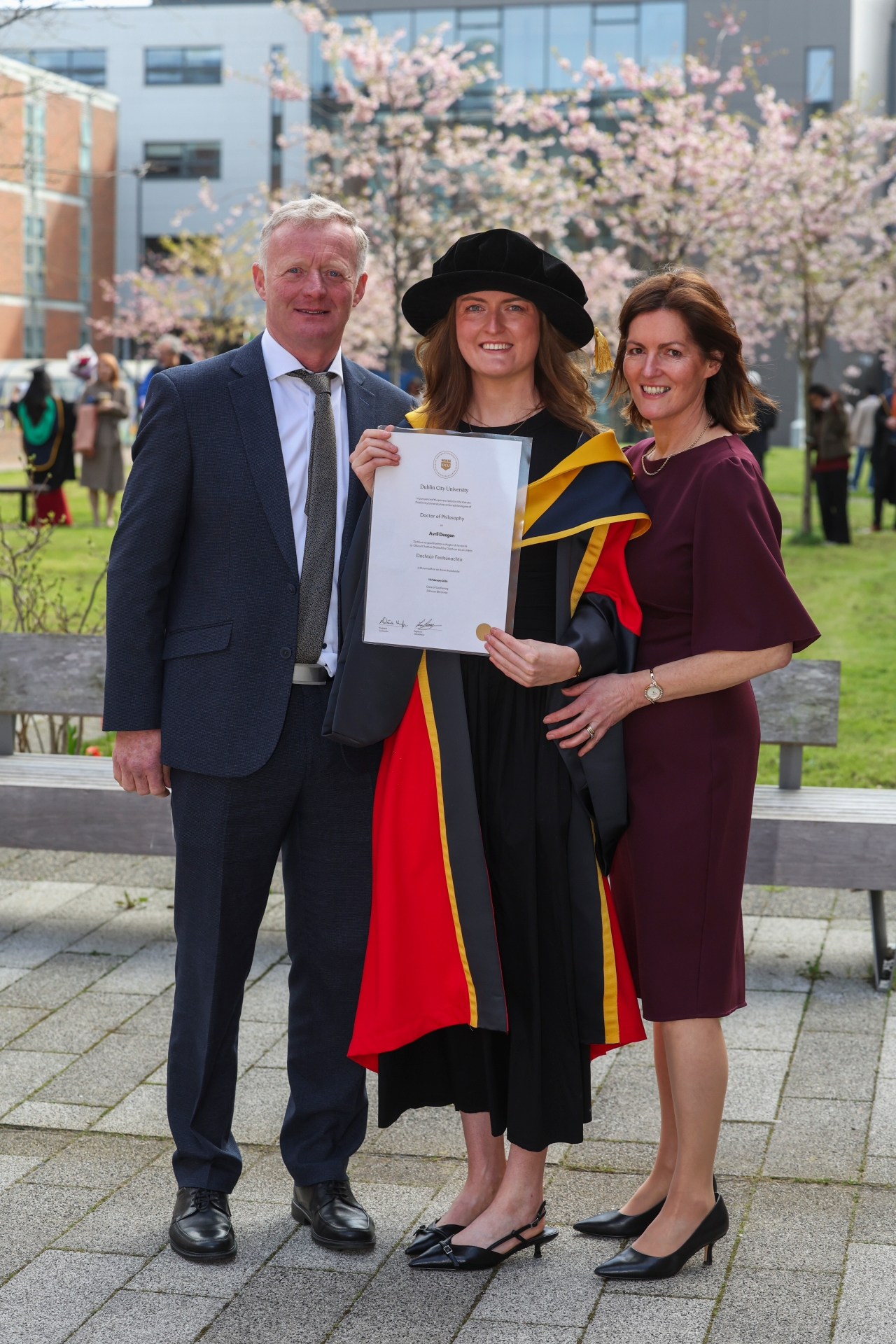
Avril with her Parents Dan and Ann Marie. Photo: Kyran O'Brien/DCU Communications
However, the experience for the parents she interviewed was quite different. Many of them were still processing the traumatic stress of their child’s illness, and had not expected how difficult it would be to return to normal work and family life.
Suddenly, the support structure of the hospital setting was taken away. “You had all the doctors, nurses, and everyone around you supporting you, but then when you got the all clear from cancer, you were just left to get back to life again.”
Avril’s research finds that the ‘support cliff’ her family experienced still exists. Ireland remains one of the few developed countries without a funded survivorship programme. “Nothing much has changed, to be honest. There's still a lack of support when you finish up treatment.”
READ NEXT: €20,000 reward announced to solve the great Laois heist a year on
Charities are doing what they can to bridge the gap, but services are concentrated in Dublin. That means families who can’t afford private counselling and other treatments often remain unsupported.
Since her PhD, Avril has landed a job with the charity Childhood Cancer Ireland, where she’s helping to address some of the issues identified in her research. One of her main projects is developing a survivorship-type programme with resources and workshops for families.
Reflecting on her PhD experience, Avril admits there were many long hours of intense work, but her efforts were inspired by the families she met during the process. “It's obviously hard for them to speak about, and yet they were willing to speak to me about it. So that was a huge motivation for me at the end, to do them justice.”
For Avril, maintaining a life beyond the PhD bubble was another key to maintaining her drive. She is an elite-level athlete who trains with DCU Athletics and Dublin City Harriers. Training six times a week made her more productive, according to Avril.
“You can't just completely go PhD for the entire 4 years,” says Avril, “I don't know how people do it if they don't have some other hobby or interest.”

Subscribe or register today to discover more from DonegalLive.ie
Buy the e-paper of the Donegal Democrat, Donegal People's Press, Donegal Post and Inish Times here for instant access to Donegal's premier news titles.
Keep up with the latest news from Donegal with our daily newsletter featuring the most important stories of the day delivered to your inbox every evening at 5pm.

This publication supports the work of the Press Council of Ireland and Office of the Press Ombudsman, and our staff operate within the Code of Practice of the Press Council. You can obtain a copy of the Code, or contact the Council, at www.presscouncil.ie, Lo-call 1800 208 080 or email: info@presscouncil.ie.