

Property prices in Laois climbs faster than other regions


Property prices in Laois rise 13.2%
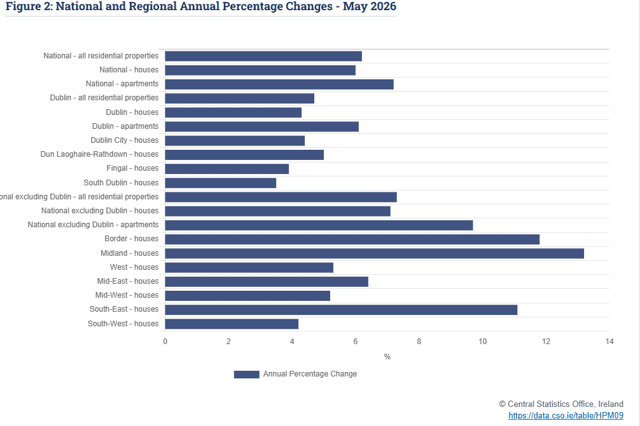
Laois property prices have risen by 13.2% in the last twelve months, with the midlands seeing the highest rate of growth nationally.
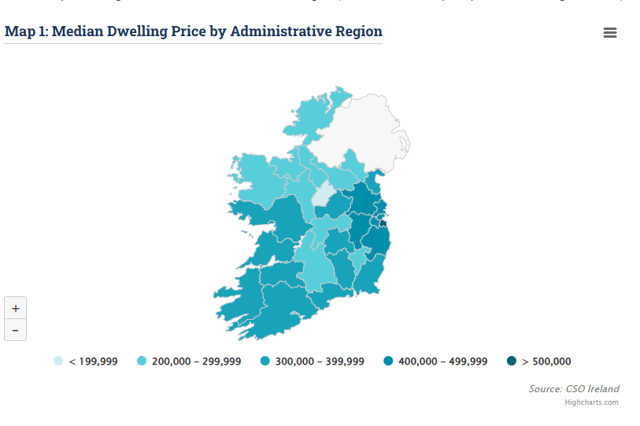
Households nationally are now paying a median price of €395,000 for a home. The median dwelling price of a home in Laois now stands at €350,000.
In Dublin, the highest house price growth was in Dún Laoghaire-Rathdown at 5.0%, while South Dublin saw a rise of 3.5%.
The regions outside of Dublin that saw the largest growth in house prices were the Midlands, comprising of Laois, Longford, Offaly, and Westmeath, at 13.2%. Border counties Cavan, Donegal, Leitrim, Monaghan, and Sligo rose at a rate of 11.8%.
On the other end of the scale, Cork and Kerry saw a 4.2% increase in house prices.
Between May 2025 and May 2026, house prices nationally rose by 6.0% while apartment prices increased by 7.2%.
In Dublin, house prices grew by 4.3%, and apartment prices were up by 6.1%. Outside Dublin, house prices were up by 7.1% while apartment prices rose by 9.7%.
The highest median price for a dwelling in the 12 months to May 2026 was €689,325 in Dún Laoghaire-Rathdown, while the lowest median price was €198,000 in Longford.
In May 2026, 3,861 dwelling purchases by households were filed with the Revenue Commissioners at a total value of €1.71 billion. These purchases were made up of 2,781 existing dwellings and 1,080 new dwellings. Revenue data shows there were 1,630 first-time buyer purchases in May 2026.
The Institute of Professional Auctioneers & Valuers ( IPAV) said the reduction of this rate, from double-digit growth in autumn of 2024 to 6.2% in April and May this year, is as ‘unsurprising as it is welcome’.
“It’s not sustainable that high increases could be maintained over a prolonged period, even with the shortage of supply. They have been on an upward trajectory since the covid pandemic,” said Genevieve McGuirk, IPAV’s Chief Executive.
Ms McGuirk said that in the current economic climate, prospective buyers are behaving more cautiously.
“Cohorts of the market are performing differently with many buyers concerned about interest rates into the future and are taking more time over their decisions and that is understandable,” she said.
Of the 20 market segments featured in the index, nine segments experienced increases, nine showed decreases, and two indicated no change.
“All eyes are now on Government measures with much anticipation that its infrastructure plan and planning changes in particular will deliver greater supply,” Ms McGuirk said.
Minister of State for Housing, John Cummins TD is introducing new planning and development regulations, a new element of housing policy that hopes to assist young people and families who find current planning rules unduly stringent.
“This could only ever help a small cohort of the market,” Ms McGuirk continued.
“Greater emphasis also needs to be placed on vacant and derelict properties to bring them back into use. It is to be hoped that the combined package of measures will deliver in an unprecedented way and lead to a sustainable housing market,” she finished.