Denis O’Donovan of Ballyryan, Donohill, Co Tipperary
Search


12 Mar 2026

Please allow ads as they help fund our trusted local news content.
Kindly add us to your ad blocker whitelist.
If you want further access to Ireland's best local journalism, consider contributing and/or subscribing to our free daily Newsletter .
Support our mission and join our community now.
To continue reading this article, you can subscribe for as little as €0.50 per week which will also give you access to all of our premium content and archived articles!
Alternatively, you can pay €0.50 per article, capped at €1 per day.
Thank you for supporting Ireland's best local journalism!

Pictured: File photo

Thanks to conservation efforts made by the National Parks and Wildlife Service, Laois County Council's Barn Owl project and the individual efforts of Laois locals, barn owls have officially returned to Laois in strong numbers.
Laois County Council carried out their Barn Owl Project in 2025, supported by the Local Biodiversity Action Fund.
The Council worked with farmers in the Ratheniska area to establish new nesting sites and to raise awareness of barn owls locally.
Having tagged and monitored the barn owls settled in Laois, the Council's Biodiversity Officer Lisa Doyle is pleased to announce that the number of barn owls in Laois has risen significantly.
"The barn owls are coming back to Laois- it's a fantastic thing," Ms Doyle told the Leinster Express / Laois Live.
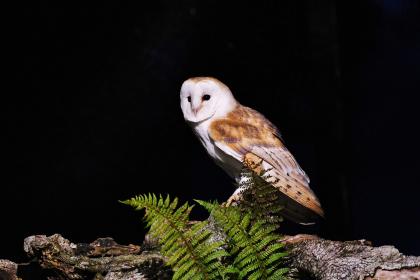
Pictured: Barn owl photographed in Ballyfin by Richard Duff
"We have issued nesting boxes to those who took part, and owls nested with a clutch of four to five eggs each in many. The project allowed us to test things out, and learn more on how best to support the conservation locally. We learned that the barn owls will generally prefer to nest indoors, where their owlettes are still sheltered when they need to eat," she explained.
The rise in barn owls locally has been attributed to various factors. A new invasive species of shrew has altered the diets of barn owls, with 40% of their diet now accounted for by the greater white-toothed shrew.
Another important factor has been the reduction in the use of poison by Laois locals.
"The fact that there are so many owls now locally is thanks to a variety of reasons, but farmers and landowners cutting down on the amount of poison they spread has been impactful," Ms Doyle highlighted.
"Barn owls love farms and hay sheds- they are natural predators, so it's a no brainer that they will eat vermin they find. No one wants vermin on their land, but spreading poison is poisoning the owls in turn," Ms Doyle explained.
"In not using the poison, you are also giving the owls the chance to take care of the problem for you, so it balances out. I would suggest people try to avoid using the poison, unless they must," she said.
"Owls are eating galore, yet we don't have the big trees other countries have for owls to roost. They are still coming back, and the biodiversity efforts have been amazing."
Ms Doyle said that an extraordinary amount of people have reported sightings of owls across Laois in the last twelve months.
"I have spoken to a lot of people and so many have seen owls around Laois. Twenty years ago, we only had 600 pairs in the country," she said.
"Conservation efforts have led to barn owls developing a stronghold in the south of Ireland, and in to Laois. One owl travelled from Laois to Cork. Lots of people are reporting sightings, particularly around hay sheds. The shrews are in there eating the grain or the hay," she said.
Laois County Council will be hosting a workshop on Tuesday March 10 in Bloom HQ Mountrath, where they will examine what they learned through last year's project.
"We will be going over the lessons we have learned, and hoping to apply these lessons to the next year of the project. When people tell me about their sightings of owls, they always say that they got a lovely feeling seeing them. They help out the farmer, and we had great results from our project.
We would love people to attend our event and learn more," Ms Doyle finished.
Join Barry Nolan, Shane Dunne and more from the Laois Barn Owl Project for a barn owl talk in Bloom HQ Mountrath on Tuesday March 10, from 7:30pm onwards.
For further details contact (087) 641 0206.

Subscribe or register today to discover more from DonegalLive.ie
Buy the e-paper of the Donegal Democrat, Donegal People's Press, Donegal Post and Inish Times here for instant access to Donegal's premier news titles.
Keep up with the latest news from Donegal with our daily newsletter featuring the most important stories of the day delivered to your inbox every evening at 5pm.

This publication supports the work of the Press Council of Ireland and Office of the Press Ombudsman, and our staff operate within the Code of Practice of the Press Council. You can obtain a copy of the Code, or contact the Council, at www.presscouncil.ie, Lo-call 1800 208 080 or email: info@presscouncil.ie.