

SEAT Arona is a Spanish surprise
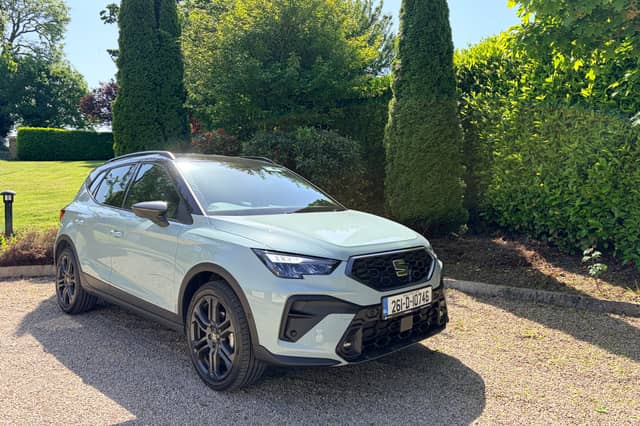

Road Test: This SEAT sports utility vehicle holds its own in a very competitive market
Seat, as most will know, is part of the Volkswagen Group, but while benefiting from VW’s undoubted engineering expertise, Seat produces a very different car to the mainstay offerings from the German parent.
The Spanish producer offers cars with a bit of flair in their style and a more sporting theme, and so it is with the updated Arona.
So what is the Arona?
Well, it's a compact SUV that is built on the same platform as the Seat Ibiza. As it is part of the VAG empire, it shares many components with the VW T-Roc and Audi Q2, but costs less than both.
The market for this type of car is pretty crowded, with almost all the major manufacturers offering compact SUVs, so this Seat has a job to do to win buyers over from mainstream brands such as Toyota with the Yaris Cross, for example, the Skoda Kamiq or Peugeot’s 2008, to name but a few.
It needs a unique selling point, and Seat claims that its USP is in its more sporty character.
So does it deliver?
The FR version certainly does offer a slightly more sporting theme with numerous cosmetic and technical details to distinguish it from its stablemates. It's been a while since I have had the chance to test a Seat, and so I was eager to find out just how this Arona stacks up.
So how does it look?
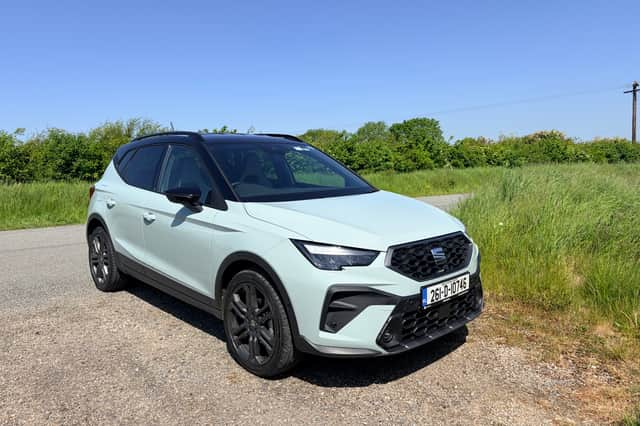
Undoubtedly, the Seat Arona is a good-looking, if somewhat unadventurous design. The styling tweaks on this FR model do give it a bit more character than the standard version, though.
The Atom Grey 18” alloys, black A-pillar, black door mirrors and black roof set off the clean lines while at the rear the two separate exhaust tips add a sporty tone.
What’s the cabin like?
Seat has done a very good job here, with the immediate impression being of a well-executed and well-built cabin. I particularly like the one-piece “bucket” sports front seats and the light coloured grey and dark grey upholstery with deviated stitching. MORE BELOW PHOTO.
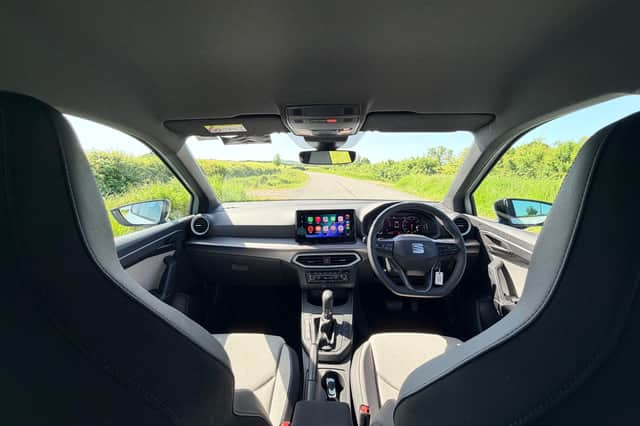
The ideal driving position is easily attainable with a reach and rake adjustable steering and driver's seat height adjustment. I particularly like the dashboard layout. The instruments are digital but can be configured to look analogue, and I think that looks way better than the basic digital readouts in so many rivals. It adds character and real design interest to the car.
The now obligatory central touchscreen is not too big, and I am pleased that Seat has a row of real buttons for the climate control functions.
The DSG gearbox has a shift lever and steering wheel-mounted paddles, all of which add to the sporty theme.
Standard equipment is very good too, with keyless Go, wireless Apple CarPlay with Android Auto, a rearview camera, LED front and rear lights, and park assist as some of the highlights. It is, however, a disappointment to find that a wireless phone charger and heated front seats are extra-cost options. These should be standard at this price point.
Overall performance is pretty good despite the on-paper figures looking a bit slow.
Accommodation is good, seating four adults in reasonable comfort, though five would be a real squeeze. The boot holds up to 400 litres and has a height-adjustable floor with a storage space underneath. Dropping the split-fold rear seats is not as handy as on some rivals, as there is no lever in the boot. Instead, you need to access the rear, lower the headrests and then flip the seats forward via a press of a manual release button. That's a bit awkward, really, for what is supposed to be a practical small SUV.
What is under the bonnet?
The Arona FR comes with a 1.0-litre TSI petrol 115 bhp turbo, mated in this case to a 7-speed DSG auto. A 6-speed manual is also available in the Arona. This lively little 3-cylinder power unit has a unique and quite attractive sound when revved, which adds to the sporty theme.
Overall performance is pretty good despite the on-paper figures looking a bit slow. Nevertheless, in practice, it goes just fine and proves lively enough. On the economy front it scores highly, burning on average just 5.6 litres per 100km over my extensive road test.
What is it like to drive?
Here is its real virtue over rivals! It’s actually quite involving to drive! On the road, it proves lively and nimble with agile handling. The suspension has been tuned to offer more sporty handling, and in that, it delivers.
The steering is well-weighted and precise in general; it proves to be an enjoyable car to drive. The fact that you can manually shift gears via the paddle shift levers adds to the enjoyment of hustling it down a twisty open road.
READ NEXT: BYD Seal 6 hybrid thinks it’s an EV
Noise levels are well suppressed, though I found there can be a bit more road noise than I would like, particularly on coarser tarmac. In short, it is the way in which it drives that puts rivals in the shade. It really is more fun to drive than pretty much all of its competitors.
Hugh’s Verdict.
The Arona FR is competing in a very competitive segment; nevertheless, it can hold its own, and while it is never going to outsell the mainstream rivals, it should continue to carve a niche for itself in the Irish market. Where it stands out over the competition is in the rewarding and indeed fun driving experience it delivers. Very few cars at this price point deliver that. For me, it is one of the more appealing cars in this segment for that very reason.
Price as tested €36,146. PROS AND CONS BELOW PHOTO.
Pros:
- A rewarding and involving driving experience.
- Practical inside.
- Quick shifting DSG gearbox.
Cons:
- Rear seat space not as good as some rivals.
- Ride can feel overly firm on some road surfaces.
- Road noise on coarse tarmac.
For more road test verdicts on new cars check out www.whicnewcar.ie