

Justice Minister tells Oireactas his department is 103m euro over budget


Jim O’Callaghan was facing the Oireachtas Justice, Home Affairs and Migration Committee on Tuesday.
The Department of Justice will be 103 million euro over budget this year, Jim O’Callaghan has told the Oireachtas.
Mr O’Callaghan was facing the Oireachtas Justice, Home Affairs and Migration Committee to examine budget supplementary estimates for An Garda Síochána, Irish prions and his department.
He said the three would need 103 million euro extra in gross terms, or a 65 million euro addition when savings were taken into consideration.
An Garda Síochaná will need a 65 million euro addition to its 2.6 billion euro budget.
The Justice Minister said this is offset by a 35.5 million euro “projected surplus in appropriations and aid receipts” for a net addition of 30 million euro.

Part of the savings arose from an underspend on Garda overtime security during Ireland’s presidency of the Council of the European Union.
Mr O’Callaghan in his projected surplus accounted for 47 million of the 125 million euro budget for events that was not spent.
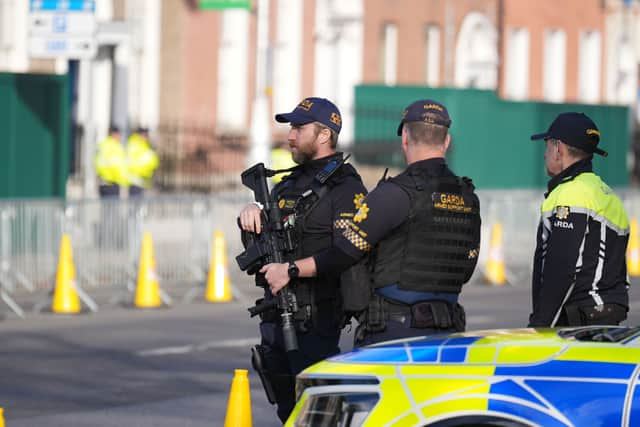
Last week saw Ireland’s biggest ever security operation for meetings of heads of state at the Convention Centre in Dublin, as part of that presidency, and the Justice Minister said policing around those events is among Garda overtime yet to be billed.
He added that an additional 55 million euro will be needed for Garda overtime this year.
“The additional funding will support the provision of additional Garda overtime hours to support frontline policing demands such as public order, special events policing and serious crime investigation,” he said.
“Policing and special events in 2026 and non-routine policing has seen the Garda play a pivotal role in ensuring the safety of our citizens and indeed visiting dignitaries.”
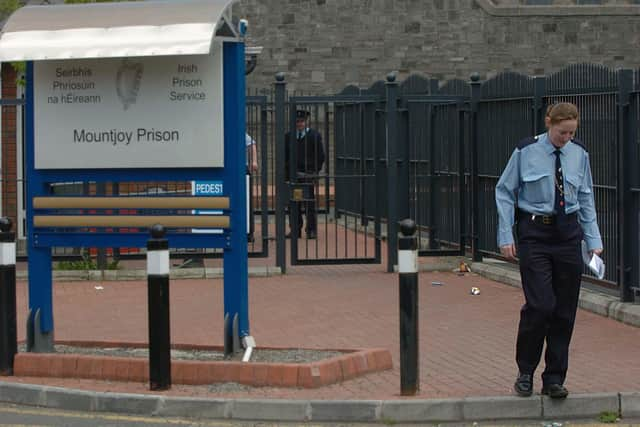
An additional 37.6 million euro is required for Irish prisons, Mr O’Callaghan told the committee, offset by a projected surplus in appropriations and aid of just under 3 million euro.
He said the 2026 allocation of more than 569 million euro will increase to 672 million euro in 2027 due to the expansion of prison spaces.
“It provides funding of 7 million euro to cover salaries and allowances of an additional 11.3 million for extra additional hours. Funding also supports additional operational expenses.
“One of the larger areas in the non-pay current expenditure across the vote relates to prisoner care and rehabilitation services, with an additional 8 million euro in that area.
“These costs are driven by the number of people in prison, which is impacting demand for medical catering, work training and mental health services, 4.7 million relates to medical costs, and 1.2 million to food provision.”
Mr O’Callaghan said that in terms of the budget for Justice, Home Affairs and Migration, there is no projected overspend, “but rather a realignment across individual expenditure lines to account for expenditure commitments in some areas”.
One of the main areas requiring funding through this supplementary process, he said, is the Ex-Gratia Stardust Recognition Payment Scheme agreed in February.
The redress initiative provides a fixed payment of 20,000 euro to injured survivors of the 1981 Stardust nightclub fire, and according to Mr O’Callaghan funding relating to this amounts to 9.2 million euro.
He said more than 500 applications have been received, and while reviews are ongoing, payments of 20,000 euro per applicant have already been issued to 300 people.
He added that extra funding will also be required to deliver shorter processing times in international protection applications.
The Fianna Fáil TD said his department is prioritising moving away from hotels being used as accommodation for these applicants, and the best way to do that is to limit the number of people claiming asylum in Ireland.
“I want to get out of having IPAS centres in hotels, but I have to be realistic as well. There’s 30,000 people who are being accommodated in IPAS accommodation at present,” he said.
“I can’t terminate lots of contracts at any particular time. The way to resolve this is to try to get the numbers of people coming in claiming asylum down, and that will mean that there won’t be a necessity to provide for accommodation.
“Part of the way to do that is through expediting the process. But I’m committed to trying to get out of retaining hotels within the IPAS portfolio.”