

Conviction for 'violent burglary' at Laois home overturned

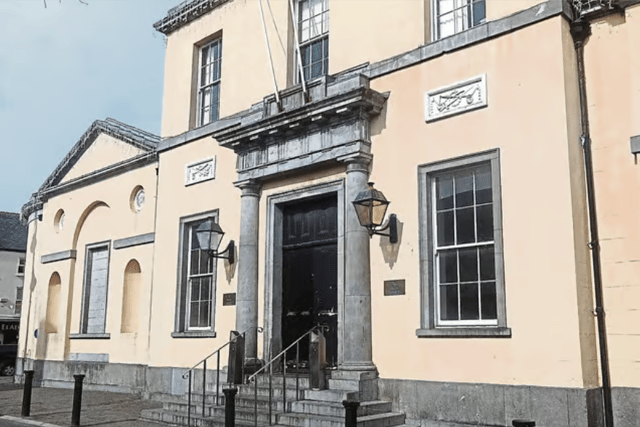

The Dublin man had been convicted at a trial in Portlaoise
A Dublin man has had his conviction overturned for a violent burglary at his former partner's home, during which another man suffered a potentially life-threatening stab wound, after the Court of Appeal ruled that "a highly irregular procedure" allowed forensic evidence to be admitted at his trial.
"The manner in which the issue of admissibility of forensic evidence found in Gavin Hanway's car was decided in his trial was unsatisfactory," said Mr Justice Alexander Owens today, directing that the appellant's appeal be allowed and he be retried.
Mr Hanway (55), of Limekiln Green, Walkinstown, Dublin was sentenced by Judge Keenan Johnson to 12 years in prison after being found guilty of assault causing serious harm to Kevin Kenny at a house in The Hermitage, Portlaoise, on July 26, 2016, following an eight-day trial at Portlaoise Courthouse in 2024.
He was also convicted by a jury of an aggravated burglary at the same address, which was the home of his former partner, Teresa Ryan, on the same date.
The trial heard evidence from Garda Sergeant Kieran Shortall that Ms Ryan was able to tell gardaí that Mr Hanway, with whom she had previously been in an on-off relationship, was the intruder.
The court heard that Ms Ryan and members of a band who had played at a wedding, including Mr Kenny, arrived at her home in the early hours of July 26, 2016. They were confronted by a male dressed in black with his face covered and carrying a knife. Sgt Shortall said that “mayhem ensued” as the intruder started waving the knife in the direction of men in the house before Mr Kenny was stabbed. The stab wound to Mr Kenny lacerated his small bowel and was potentially life-threatening without appropriate treatment.
Sgt Shortall said that a “standout feature” of the incident was how the attacker approached Ms Ryan, who was cowering in a corner, and stated: “I told you I would get you back.”
Mr Hanway denied any role in the incident after gardai arrested him and claimed he was in a cousin’s home in Dublin at the time, although he accepted he was in Portlaoise a short time earlier. However, a forensic examination of his car found glass fragments from Ms Ryan’s house.
In launching an appeal against conviction in July, counsel for the appellant, James Dwyer SC, said that the car was seized under warrant. He said that the arresting garda had given evidence that the warrant was in the name of another garda, who did not attend with him on the day.
Counsel for the Director of Public Prosecutions, Aoife O’Leary BL, said the trial judge had ruled that the seizure of the car was not a breach of Mr Hanway’s constitutional rights. She said that although the judge found that this evidence had been illegally obtained, he subsequently applied the legal test to this evidence and ruled it admissible in the interest of justice.
In delivering the court's judgment today, Mr Justice Owens noted that during the trial, a voir dire took place as to whether the glass fragments should be admitted as the car had been left open before the gardaí seized it.
He said that, notwithstanding that the purpose of the voir dire had nothing to do with the legal basis on which the car was seized, the defence team for Mr Hanway then proceeded to submit to the court that the car had been seized in breach of his constitutional rights.
"This submission was completely untethered to the reason advanced when the voir dire was requested," said Mr Justice Owens, adding that the defence team did not argue that the car was taken in circumstances of unconstitutionality until after the voir dire.
He said that the trial judge was invited to decide on the admissibility of the evidence on the basis of non-evidential assertions.
"This was a highly irregular procedure and the judge should not have been invited to decide this issue on the basis of these assertions," said Mr Justice Owens, going on to say that "the trial judge was not assisted by the prosecution's apparent willingness to engage with this irregular procedure".
As no evidence was put before the trial judge relating to the lawful authority for the gardaí to take the car, Mr Justice Owens said the judge could therefore not determine that the evidence obtained from the forensic examination of the car was admissible.
"The manner in which the issue of admissibility of forensic evidence found in Gavin Hanway's car was decided in his trial was unsatisfactory" he said.
Mr Justice Owens said the trial judge should have declined to rule on the challenge to admissibility arising from the seizure of the car by gardai on the grounds that this issue was not the basis of the challenge by the defence. He said the correct course for the defence was to apply for a fresh voir dire and identify to the court and the prosecution all of the grounds on which it sought to challenge the admissibility of the evidence gleaned from the car.
Accordingly, the court ruled that it would allow the appeal and direct a retrial.
"We hope that this will be the last occasion on which a trial judge will be asked to decide on admissibility of evidence in the manner in which the issues were presented to the trial judge for determination here. Future defendants who proceed in that manner may well find that they have to live with the adverse consequences of failing to adhere to proper procedures," said Mr Justice Owens.
The appellant was granted bail, with the matter to be sent back to Portlaoise Circuit Court.