

‘We can’t keep picking up these bills’ – Laois councillors bemoan unfinished housing estates
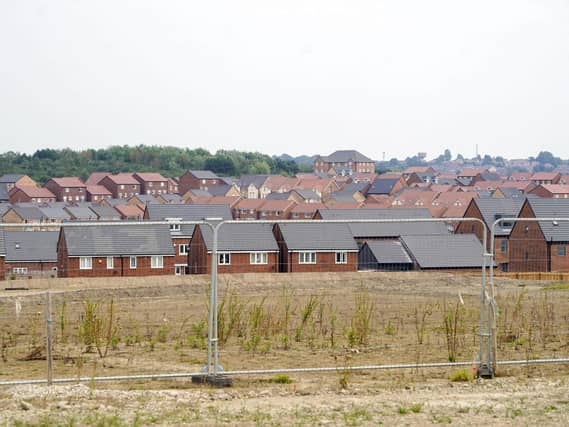

Laois councillors say housing estate developers should pay for road features and seek stronger planning conditions
Laois councillors have expressed frustration over the cost to the council of installing road features in housing estates.
At the October meeting of Laois County Council, Cllr Tommy Mulligan said that while he has no issue “helping out”, installing ramps, paint markings and other traffic calming measures should be the developers’ responsibility.
He said: “I receive numerous requests from residents associations around road safety in estates – and mostly the, say, modern estates and the large scale developments. And the requests are from signage down to paint markings to chicane lanes, chicane islands, to ramps. And I've no problem helping out, but some of these jobs are expensive.
“What’s happening is, it’s falling back on the councillors, and it’s falling back on Laois County Council, and I don’t think that’s fair. I think it should be falling back on the developer.”
Laois County Council already requires developers to submit comprehensive traffic data and strategy frameworks for major construction schemes.
Cllr Mulligan suggested that the council needs “stricter road safety requirements as part of the planning application.”
He also suggested that the requirements need stronger enforcement, saying: “Developers should be required to demonstrate that all appropriate traffic calming measures and speed restrictions are in place. Because often it happens that they’re leaving estates, and it’s not in place.”
He proposed that housing estates be subject to a road safety inspection six or twelve months after construction concludes, to ensure that the traffic calming features meet the realised needs of the estate.
Director of Services at Laois County Council Angela McEvoy noted that a road safety audit is already conducted on housing estates a period after completion. She suggested that a follow-up may be required for estates about which councillors have concerns.
Cllr Caroline Dwane Stanley expressed doubts that developers could be held accountable for the installation of road features, suggesting that developers are not complying with several of their existing obligations.
“If we were to get what [Cllr Mulligan] is looking for it would be great, but unfortunately, in reality, on the ground, [from] my dealings anyway with a couple of estates, including my own – we can’t get them. We can’t get the builder to actually turn on the lights in the winter. We can’t get them to address derelict sites, vacant sites, in the estate, footpaths, and I’m not just talking about the cosmetics: sewage, sometimes the sewage is the problem, the drainage.”
Cllr Dwane Stanley noted that when the council takes charge of unfinished estates, it relieves developers of their responsibilities under the planning conditions. In the past, she said, she has prolonged allocating council funding to unfinished estates so the developers will complete the works, as is their obligation.
She highlighted a development in Kilminchy where there are €150,000 of unfinished works. The builder’s attitude, she said, was: “we only bought from the curb into the front door.”
“We can’t keep picking up these bills,” Cllr Dwane Stanley said. “The traffic calming is vital. In my own estate there’s not even a screed of a white line in it. You come out at the main entrance and there’s three junctions, nobody knows who has the right of way.”
Cllr Paddy Bracken also expressed frustration over councillors having to use their ‘discretionary funding’ on traffic calming measures in estates and advocated for a “strong policy” on the issue.